
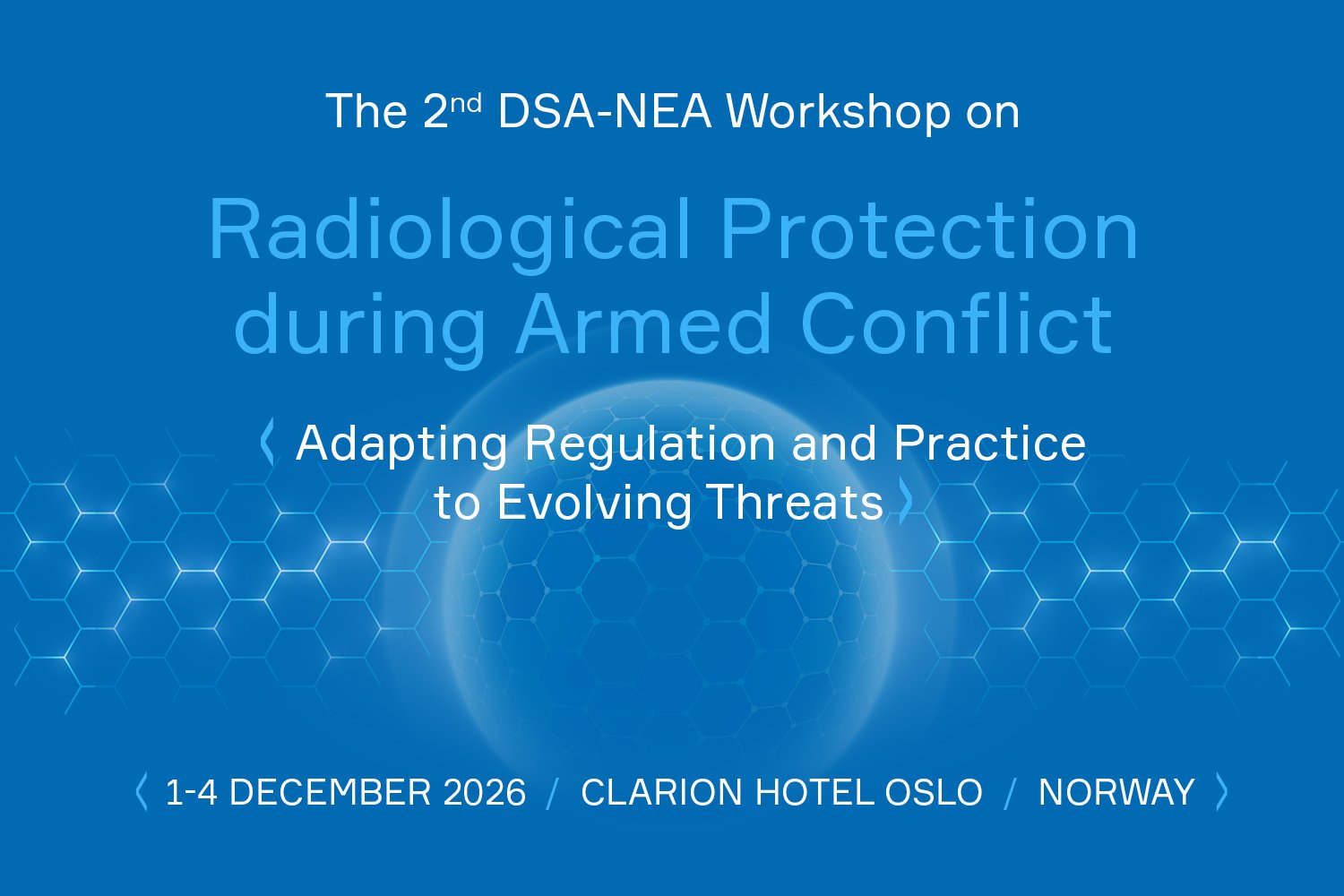
The Norwegian Radiation and Nuclear Safety Authority (DSA) and the OECD Nuclear Energy Agency (NEA) supported by the International Commission on Radiological Protection (ICRP) Task Group 120 will bring together regulators, operators, technical and scientific experts, emergency preparedness specialists, medical professionals and international organizations for the second joint DSA–NEA Workshop on Radiological Protection During Armed Conflict.
Conference DB – registration link
Expression of Interest to Contribute to the RP during Armed Conflict Workshop Programme – expression of interest link
From the 2023 workshop to TGRPAC
The first DSA–NEA workshop on Radiological Protection During Armed Conflict was held in Oslo in November 2023 and brought together 130 experts from 28 countries and international organizations.
The workshop demonstrated that armed conflict can challenge assumptions normally underpinning radiological protection and emergency preparedness arrangements. Regulatory oversight, monitoring, communication, access to facilities, staffing, infrastructure and international co-operation may all be affected simultaneously and for prolonged periods.
The findings of the 2023 workshop contributed to the establishment of the NEA Task Group on Radiological Protection During Armed Conflict (TGRPAC).
The 2026 workshop represents the next stage of this work. Discussions will examine how RP principles and regulatory expectations can continue to be implemented when the systems and capabilities normally supporting them are degraded.
From expert discussion to practical decision-making
The workshop is designed as an interactive working forum. Plenary sessions and selected case studies will be combined with structured expert discussions bringing together regulatory, operational and scientific perspectives. Participants will examine practical dilemmas such as:
- What minimum regulatory, operational and analytical functions must be preserved?
- What information is sufficient to support a defensible decision when monitoring or verification is incomplete?
- How should radiological protection be optimized when radiological risks compete with immediate physical, security or humanitarian risks?
- How can regulatory responsibility and accountability be maintained when access or direct oversight is restricted?
- When may adaptive approaches be justified, and which protective requirements should remain non-negotiable?
- What happens when the preferred radiological protection option cannot practically or safely be implemented?
The findings from these discussions will feed directly into the tabletop exercise and the final workshop synthesis.
Tabletop exercise: decision-making under degraded conditions
A major component of the 2026 workshop will be an interactive tabletop exercise exploring radiological protection and regulatory decision-making during prolonged armed conflict.
The exercise will not simulate a conventional nuclear emergency or ask participants simply to select standard protective actions. Armed conflict will instead form the continuing environment in which radiological protection decisions must be made.
Participants will work with fictional scenarios in which information, institutional capacity, access, monitoring, communications or operational resources are progressively degraded.
The scenarios will be examined from three complementary perspectives:
- Regulatory and governance – responsibility, authority, oversight, accountability and the defensibility of decisions;
- Scientific and technical support – monitoring, modelling, uncertainty, verification and the sufficiency and reliability of evidence; and
- Operational implementation – what can realistically be implemented when access, staff, infrastructure, logistics or other essential resources are constrained.
The exercise is intended to turn the workshop into a practical decision-making laboratory and to generate observations that can contribute directly to the work of TGRPAC and the development of future recommendations.
Key areas of discussion
The workshop will address radiological protection as an interconnected system and explore, among other issues:
- Regulation and international frameworks
Maintaining regulatory functions, oversight, accountability and implementation of existing standards and international commitments under degraded conditions. - Information, monitoring and decision support
Decision-making when monitoring networks are disrupted, information is incomplete or conflicting, modelling is uncertain, or independent verification is difficult. - Emergency preparedness, response and recovery
Maintaining protective capabilities during prolonged disruption and considering the transition from immediate response to longer-term continuity and recovery. - Nuclear facilities and supporting infrastructure
Maintaining essential safety functions and meaningful regulatory oversight when nuclear facilities or supporting energy infrastructure are affected by military threats, occupation, physical damage or loss of access. - Medical radiological protection
Maintaining essential diagnostic and therapeutic services while preserving radiation protection, quality assurance and regulatory control in disrupted healthcare systems. - Human factors, safety culture and ethical decision-making
Understanding how prolonged pressure, reduced staffing, uncertainty, competing risks and difficult choices affect the people and organizations responsible for maintaining radiological protection.
Who should attend?
The workshop is intended for professionals involved in radiological protection, nuclear and radiation safety, emergency preparedness and response, and the practical implementation of protective measures.
Participants are expected to include:
- national and local authorities and regulatory bodies;
- nuclear facility operators and other licensees;
- technical and scientific support organizations;
- radiation protection and emergency preparedness professionals;
- medical and health professionals;
- specialists in monitoring, modelling and decision support;
- international organizations and professional associations;
- researchers, academics and students working in relevant fields.
Participants with operational, regulatory or technical experience from conflict-affected or otherwise severely disrupted environments are particularly encouraged to contribute.
Practical information
- Dates: 1–4 December 2026
- Venue: Clarion Hotel, Oslo, Norway
- Language: English. No interpretation will be provided.
- Maximum number of participants: 150
- Registration fee: EUR 200
- Reduced fee: EUR 100 for students, retirees and unemployed participants. Waivers may be considered in exceptional cases.
The registration fee includes participation in the workshop, workshop materials, coffee breaks and lunches, and the evening reception.
- Registration deadline: 31 October 2026
- Payment deadline: 10 November 2026
- Cancellation with refund: until 10 November 2026
Participants requiring a visa to enter Norway should register by 20 September 2026 to allow sufficient time for preparation of invitation letters.
Contribute to the programme
The DSA and NEA welcome expressions of interest from participants wishing to contribute presentations, case studies, national or regulatory experience, operational lessons, or expertise to panel and tabletop discussions.
Submissions will be reviewed by the organizers and Programme Committee against the objectives and thematic scope of the workshop. Submission of an expression of interest does not guarantee inclusion in the final programme.
Selected contributors will participate in the workshop free of charge.
Expression of Interest to Contribute to the RP during Armed Conflict Workshop Programme
Registration and further information:
Register through the NEA event page: Conference DB
Official NEA workshop page: Nuclear Energy Agency (NEA) - Radiological Protection during Armed Conflict: Adapting Regulation and Practice to Evolving Threats
Read the report from the 2023 DSA–NEA workshop: Radiological Protection During Armed Conflict: Improving Regulatory and Operational Resilience
Learn more about the NEA Task Group on Radiological Protection During Armed Conflict (TGRPAC): Nuclear Energy Agency (NEA) - New NEA task group to work on radiological protection during armed conflict
For questions concerning the workshop, please contact:
Karina Ubøe: karina.uboe@dsa.no